
The short answer to car detailing vs car wash: a wash removes surface dirt so the car looks cleaner today, while a detail cleans, decontaminates and protects every surface so it stays in better condition long term. Both have a place, and the right one depends on what your car needs right now.
On the Gold Coast the gap between them is bigger than you might think. Salt film and fine beach sand make some quick washes riskier for your paint, and humid air means a quick vacuum rarely deals with cabin smells. Here's how they compare and when each one makes sense. If you already know you want a proper clean, see our Gold Coast car detailing services.
What a car wash actually does
A car wash is designed to be fast and affordable. Most fall into three groups: automatic tunnel or rollover washes with spinning brushes, touchless washes that rely on high-pressure water and strong chemicals, and hand wash stations where staff clean the car while you wait.
All three focus on the visible exterior, and some add a quick vacuum and a wipe of the dash. That's useful for keeping on top of everyday dust, but it doesn't go much further.
- Removes loose dust, mud and road grime from the paint
- Gives the glass and wheels a basic clean
- Sometimes includes a quick vacuum of carpets and seats
- Leaves bonded contamination, stains, odours and paint defects behind
What car detailing involves
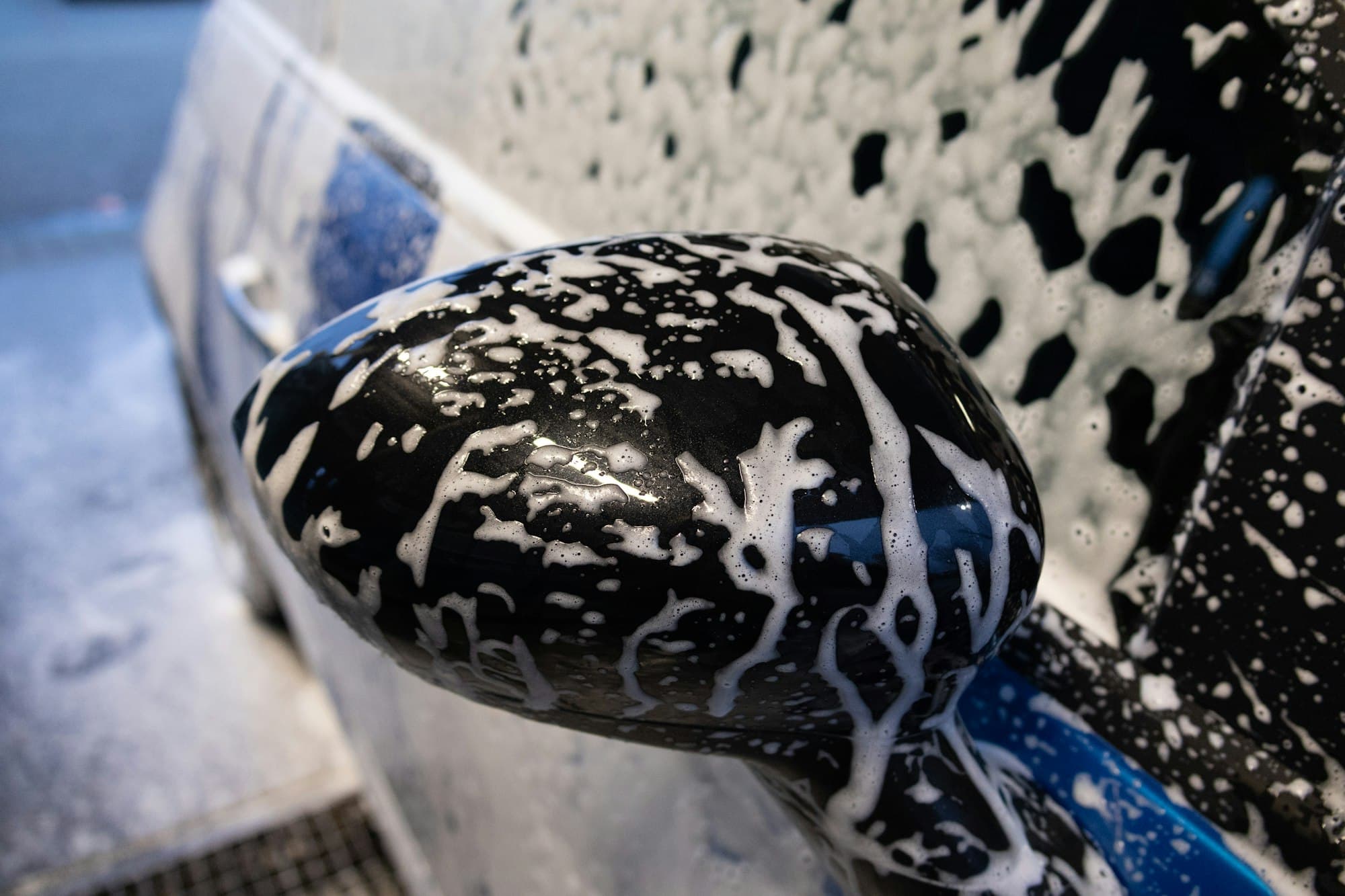
Detailing is a methodical clean of the whole vehicle, with time spent on each area. Outside, it starts with a snow foam pre-wash that softens grime and lifts grit before the paint is touched, followed by a careful hand wash. Higher-level packages add iron decontamination to dissolve metal particles that a wash leaves behind.
Inside, a detail means thorough vacuuming, steam cleaning, stain treatment and leather care. Steam reaches into vents, seams and cup holders, and it helps lift the stale smells that build up in humid weather. You can see exactly what's included in our interior and exterior packages.
Correction and protection
Detailing can also go beyond cleaning. Paint correction polishes out swirls and scratches after the paint depth is measured, and a ceramic coating adds a protective layer that makes future washing easier. A car wash simply isn't set up to do either.
Car detailing vs car wash: the key differences
- Time: a wash takes minutes, while a detail takes hours, from about 1 to 2 hours for a Mini Detail to 5 to 6 hours for a Signature package.
- Washing method: brush washes can drag grit across paint, while a detail uses a pre-wash and hand wash to lift dirt first.
- Interior: a wash may include a quick vacuum, while a detail includes steam cleaning, stain treatment and leather care.
- Contamination: a wash leaves bonded fallout behind, while higher-tier details include iron decontamination.
- Protection: a wash may add a spray wax that fades quickly, while detailing can include long-term ceramic protection.
- Cost: a wash is cheaper per visit, while a detail starts from $145 for an exterior Mini Detail and $245 for the Sapphire inside and out package.
Why salt and sand make automatic washes riskier on the coast
Every automatic wash relies on the same idea: wet the car, apply soap, and use brushes or cloth strips to scrub it clean. The trouble is that those brushes clean a long line of cars every day. Grit picked up from one car can be dragged across the next.
Gold Coast cars carry more of that grit than most. Fine beach sand collects in panel gaps, along sills and around the wheels, and salt dries into a gritty film on paint and glass. If that layer isn't softened and rinsed away before contact, the brushes rub it into the clear coat. Over time the result is the fine circular scratches you notice in direct sunlight, known as swirl marks.
Touchless washes avoid brushes, but they need harsher chemicals to make up for the lack of contact. Repeated use can strip wax and sealants faster and often leaves a thin layer of traffic film behind. Neither type does anything for the inside of the car.
What about self-serve wash bays?
Self-serve bays can be a decent middle ground if you bring your own clean mitt and buckets. Skip the foaming brush on the wall, since everyone uses it and it often holds grit. A thorough rinse with the pressure wand before touching the paint makes a big difference.
What about waterless and rinseless washes?
Waterless sprays and rinseless washes are popular with apartment dwellers who don't have a hose handy. They work by lubricating light dust so it can be lifted with a plush microfibre towel. On a car with only a light film of dust, they're a handy tool.
On a car carrying sand or salt grit, they're risky, because the towel can drag those particles across the paint. Rinse a sandy car first, or leave it for a proper wash.
When a car wash makes sense
A wash is fine for keeping a well-maintained car tidy between details. It's the quick option after a trip to the beach, when the car has a light coat of dust, or when you just want it presentable for the week.
Think of a wash as maintenance and a detail as a reset. A car tends to stay in the best shape when it gets both.
- Your car was detailed recently and only has light surface dust
- You need to rinse off salt spray after a coastal drive
- The paint is ceramic coated and you're using a touchless or careful hand wash
- You're short on time and the interior is already clean
When to book a detail instead
A detail is the better choice when a wash won't fix the problem, or when you want the car protected rather than just clean for a few days.
- Sand is ground into the carpets and won't come out with a vacuum
- There's a musty smell from humidity, wet towels or spilled drinks
- The paint feels rough or looks dull even straight after a wash
- You're selling the car and want it to photograph well, which is what our pre-sale detailing is for
- You've just bought a car and want to start with clean, protected paint
- Swirl marks are visible in direct sunlight
Many owners combine the two, with a professional detail every few months and careful washes in between. Our guide on how often to detail your car explains how to space them for coastal driving, and our price guide lists every package.
Making either option kinder to your paint
If you use a car wash, choose a hand wash or touchless option over brushes, and rinse a sandy car at home first. Dry it with a clean microfibre towel rather than letting it air dry in the sun, which leaves water spots that can etch in the heat.
If you wash at home, use two buckets, one for soapy water and one for rinsing the mitt, and work from the roof down. Keep a separate mitt for the wheels. These habits keep the paint in far better shape between professional visits.
Want to see what a proper detail does for your car? Request a free quote. Preema comes to your home or workplace anywhere from Coolangatta to Ormeau, with no call-out fee.